Recovery Of Coconut Oil
pp. 1-2 · Read in the full issue
———♦——— American Chemist Introduces a New Bacterial Process CLAIMED TO BE MUCH CHEAPER AND BETTER
Than Crushing
A DISCOVERY of first-rate importance to the copra industry was made in 1929 by an American chemist, Mr. John W. Beckman, of California.
It is described in the following article, which is taken from a paper written by Mr. Beckman and entitled “Recovery of Vegetable Oils and Fats by a Bacterial Process.”
“The process,” says Mr. Beckman, in a letter to The Pacific Islands Monthly, “works perfectly on coconuts; and one of the largest coconut-oil producers in the world is at present (April, 1931) carrying on extensive experiments and investigation of the process, with the idea of installing same at various points. It may interest you to know that a plant, using the same principle, is going to be installed in India for the manufacture of ground-nut oil.”
Mr. Beckman’s paper, presented to a learned body in America, follows:
FATS have from time immemorial been a food essential to the human race, as well as an accessory in the arts and in the toilette.
The recovery of this essential article has from the very first been by means of pressure after the fat-carrying material had received suitable preliminary treatment. As technical skill has advanced, the methods of applying pressure have been improved and the pressure has been increased, until at present it seems as if the ultimate in pressure has been attained. There remains, so far as the pressure methods are concerned, only the improving of the accessory treatment of the materials crushed.
The vegetable-oil industry is justly rated as a chemical industry, since the ultimate product is a chemical and the material in which the oil is contained is of a chemical nature, though the method of recovery as practiced to date is mechanical only. Some late developments have been made of extracting the oil with a solvent, but the use of this process is so limited that no reference has been made to it here.
And it has seemed as though there were no other possible approach for the recovery of the oil considering the nature of the raw material and the delicacy of the oil.
Take, for example, the coconut, which contains in its dried condition as copra about 64 per cent, of oil. The oil-containing cells are so small that even by passing the dried nut through a grinding mill only a limited amount of oil is freed and the cell walls are so tough that added troubles are encountered when the oil is expelled by mechanical means. Therefore, various
high-temperature treatments of the nut are necessary before the cell walls become brittle enough to crush under the high pressure and so release the oil.
Theoretical Basis of Process The cell walls are composed of cellulose, other carbohydrates like sugars, and proteins. It would appear that these facts might suggest a chemical means of liberating oil from vegetable oilbearing materials. If so, the problem then evolves around how to find some solvent for the cell walls that will liberate the oil, so that it may be ——— ... Bacterial Oil Separation Flow Sheet Calcium Carbonate ... Copra ... Water ... Bacteria ... \ ... ... / ... ... Grinding ... ... \ . ... / ... ... Mixing ______________⏌ ... ... Incubator ... ... ⌐——— Oliver Filter ... ... ... ... Oil, Water, Bacteria ... ... Settling Pulp Drier ... Oil Storage ... ... ... ... ... Evaporators ... Oil ... ... ... ⌞___________ Cattle Feed ———
recovered without any high pressure other than that used on a filter press.
It seems unlikely that any inorganic substance could be found that would attack at least two of these substances and make them water-soluble, and in so doing would not affect either the oil or the residue, which is very valuable as a cattle feed. The other alternative would be to find some organic means in the shape of enzymes or similar substances that might attack the cell walls, making them in whole or part water-soluble, and in such fashion break down the cells and release the oil. Such a process should not involve many steps and should be simple both in principle and in actual operation. Preferably also should the enzymes be formed directly through some action upon the substances contained in the cell walls themselves.
There is a very prevalent hardy and vigorous anaerobic and thermophilic bacterium, Bacillus delbruecki, that is easy to obtain from brewer’s malt, which will attack sugars, changing them into lactic acid, and produce in so doing an enzyme which vigorously attacks proteins, changing them into water-soluble amino acids. This bacterium has been pressed into service in a new oil-recovery process not based upon the old principle of pressure.
The temperature at which these organisms prefer to work is 50 deg. C., and this fact makes it possible to operate under conditions that are selfsterilising, since most organisms are either killed at that heat or inhibited in their activities. If a culture of this organism made from brewer’s malt is mixed with disintegrated nuts, such as copra, together with a weighed amount of ground limestone and sufficient water to form a mush, and the result ing mixture is placed in an incubator at the desired temperature, with exclu-
(Continued On Page 2)
carbon dioxide is given off by the action of the lactic acid upon the calcium carbonate, and free oil begins to appear on the surface; at the same time the mixture becomes more and more liquid. After about 6 days the gas evolution comes to an end and the oil can be recovered from the residue by filtration. Thus the first step has been taken in changing the vegetable oil industry into a truly chemical one.
The quality of the oil depends, of course, much upon the quality of the original copra. For example, a copra showing free-fatty-acid content of 1.94 per cent, gave at the end of the fer mentation 2.1 per cent., while a copra that contained oil of a free-fatty-acid content of 10.6 per cent, gave at the end of fermentation 13.00 per cent, free fatty acids. It is well known that free fatty acids act as catalysts and materially increase the rate of decomposition of the oil. The pH averages uniformly about 4.2. This acid condition is maintained by the use of excess amounts of calcium carbonate. The free fatty acids are readily produced by the lipases formed by the action of molds, but with properly covered incubators the temperature is kept such that the mold has no chance to grow and the danger of oil decomposition due to lipases is practically negligible.
The colour of the oil produced is superior to the average obtained by the usual pressure methods, and its melting point is normal.
If the bacterial process is applied to fresh nuts, a water-white oil of exceptionally high quality is obtained.
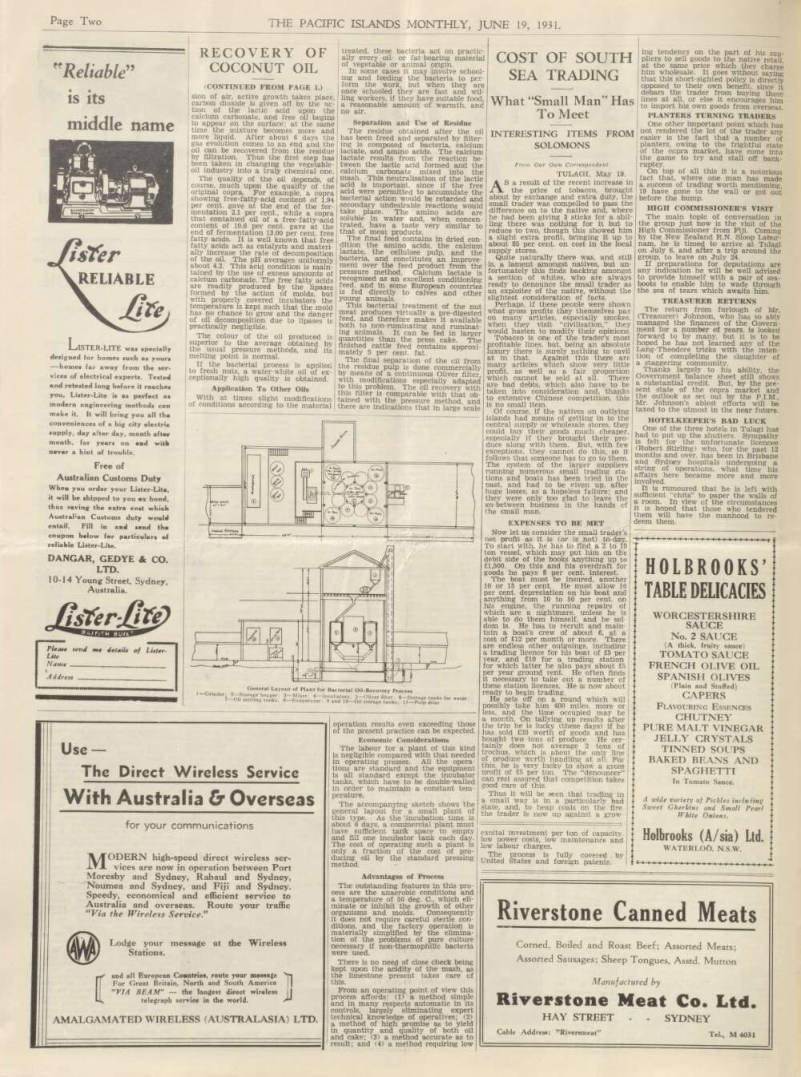
Application To Other Oils With at times slight modifications of conditions according to the material General Layout of Plant for Bacterial Oil-Recovery Process Grinder; 2— Storage hopper; 3—Mixer; 4—Incubators; 5—Oliver filter; 6—Storage tanks for water: 7-Oil settling tanks. 8—Evaporator; 9 and 10 —Oil storage tanks; 11—Pulp drier
treated, these bacteria act on practically every oil or fat-bearing material of vegetable or animal origin.
In some cases it may involve schooling and feeding the bacteria to perform the work, but when they are once schooled they are fast and willing workers, if they have suitable food a reasonable amount of warmth, and no air.
Separation and Use of Residue The residue obtained after the oil has been freed and separated by filter ing is composed of bacteria, calcium lactate, and amino acids. The calcium lactate results from the reaction be tween the lactic acid formed and the calcium carbonate mixed into the mash. This neutralisation of the lactic acid is important, since if the free acid were permitted to accumulate the bacterial action would be retarded and secondary undesirable reactions would take place. The amino acids are soluble in water and, when concen trated, have a taste very similar to that of meat products.
The final feed contains in dried condition the amino acids, the calcium lactate, the cellulose pulp, and the bacteria, and constitutes an improvement over the feed product from the pressure method. Calcium lactate is recognised as an excellent conditioning feed, and in some European countries is fed directly to calves and other young animals.
This bacterial treatment of the nut meat produces virtually a pre-digested feed, and therefore makes it available both to non-ruminating and ruminating animals. It can be fed in larger quantities than the press cake. The finished cattle feed contains approximately 5 per cent. fat.
The final separation of the oil from the residue pulp is done commercially by means of a continuous Oliver filter, with modifications especially adapted to this problem. The oil recovery with this filter is comparable with that obtained with the pressure method, and there are indications that in large scale
operation results even exceeding those of the present practice can be expected.
Economic Considerations The labour for a plant of this kind is negligible compared with that needed in operating presses. All the operations are standard and the equipment is all standard except the incubator tanks, which have to be double-walled in order to maintain a constant temperature.
The accompanying sketch shows the general layout for a small plant of this type. As the incubation time is about 6 days, a commercial plant must have sufficient tank space to empty and fill one incubator tank each day.
The cost of operating such a plant is only a fraction of the cost of producing oil by the standard pressing method.
Advantages of Process The outstanding features in this process are the anaerobic conditions and a temperature of 50 deg. C., which eliminate or inhibit the growth of other organisms and molds. Consequently it does not require careful sterile conditions, and the factory operation is materially simplified by the elimina tion of the problems of pure culture necessary if non-thermophilic bacteria were used.
There is no need of close check being kept upon the acidity of the mash, as the limestone present takes care of this.
From an operating point of view this process affords: (1) a method simple and in many respects automatic in its controls, largely eliminating expert technical knowledge of operatives; (2) a method of high promise as to yield in quantity and quality of both oil and cake; (3) a method accurate as to result; and (4) a method requiring low
capital investment per ton of capacity, low power costs, low maintenance and low labour charges.
The process is fully covered by United States and foreign patents. ===