How Fiji Is Facing the Depression
p. 10 · Read in the full issue
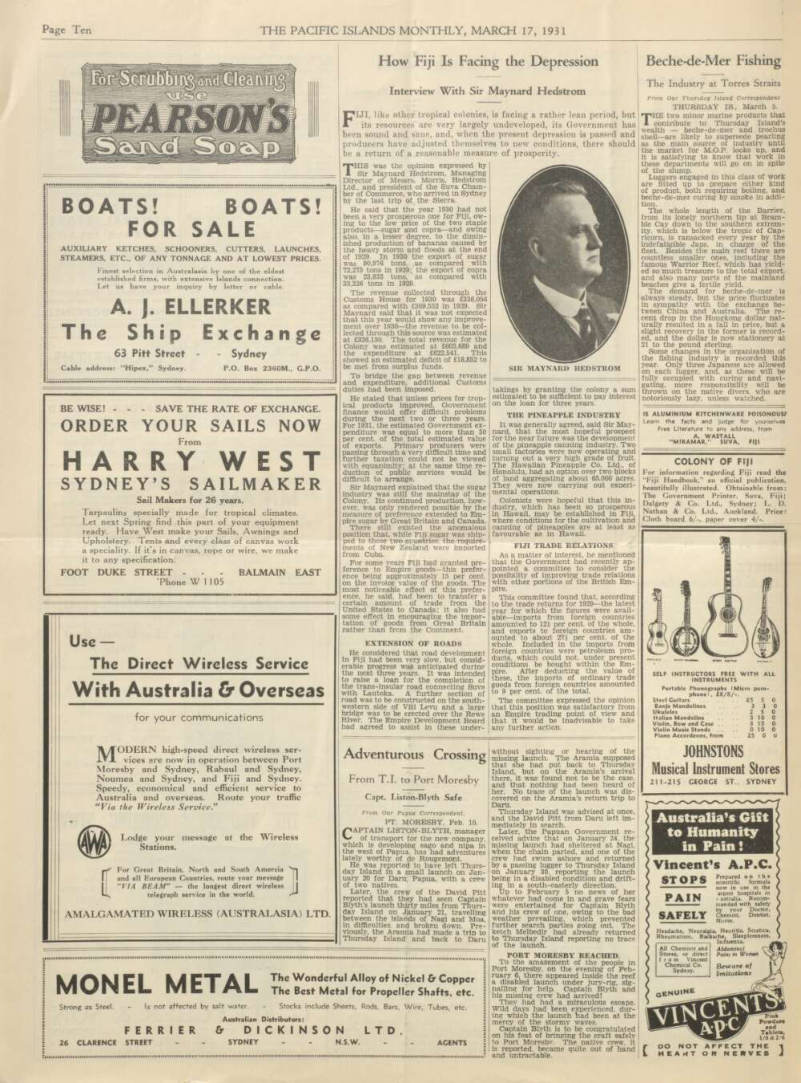
Interview With Sir Maynard Hedstrom
FIJI, like other tropical colonies, is facing a rather lean period, but its resources are very largely undeveloped, its Government has been sound and sane, and, when the present depression is passed and producers have adjusted themselves to new conditions, there should be a return of a reasonable measure of prosperity.
THIS was the opinion expressed by Sir Maynard Hedstrom, Managing Director of Messrs. Morris, Hedstrom Ltd., and president of the Suva Cham ber of Commerce, who arrived in Sydney by the last trip of the Sierra.
He said that the year 1930 had not been a very prosperous one for Fiji, ow ing to the low price of the two staple products—sugar and copra—and owing also, in a lesser degree, to the dimin ished production of bananas caused by the heavy storm and floods at the end of 1929. In 1930 the export of sugar was 90,976 tons, as compared with 72,275 tons in 1929; the export of copra was 23,833 tons, as compared with 33,226 tons in 1929.
The revenue collected through the Customs House for 1930 was £336,056 as compared with £369,552 in 1929. Sir Maynard said that it was not expected that this year would show any improve ment over 1930—the revenue to be col lected through this source was estimated at £326,130. The total revenue for the Colony was estimated at £603,689 and the expenditure at £622,541. This showed an estimated deficit of £18,852 to be met from surplus funds.
To bridge the gap between revenue and expenditure, additional Customs duties had been imposed.
He stated that unless prices for trop ical products improved. Government finance would offer difficult problems during the next two or three years.
For 1931, the estimated Government ex penditure was equal to more than 50 per cent, of the total estimated value of exports. Primary producers were passing through a very difficult time and further taxation could not be viewed with equanimity: at the same time re duction of public services would be difficult to arrange.
Sir Maynard explained that the sugar industry was still the mainstay of the Colony. Its continued production, how ever, was only rendered possible by the measure of preference extended to Em pire sugar by Great Britain and Canada.
There still existed the anomalous position that, while Fiji sugar was ship ped to those two countries, the require ments of New Zealand were imported from Cuba.
For some years Fiji had granted pre ference to Empire goods—this prefer ence being approximately 15 per cent, on the invoice value of the goods. The most noticeable effect of this prefer ence, he said, had been to transfer a certain amount of trade from the United States to Canada; it also had some effect in encouraging the impor tation of goods from Great Britain rather than from the Continent.
Extension Of Roads
He considered that road development in Fiji had been very slow, but consid erable progress was anticipated during the next three years. It was intended to raise a loan for the completion of the trans-insular road connecting Suva with Lautoka. A further section of road was to be constructed on the south western side of Viti Levu and a large bridge was to be erected over the Rewa River. The Empire Development Board had agreed to assist in these under
takings by granting the colony a sum estimated to be sufficient to pay interest on the loan for three years.
The Pineapple Industry
It was generally agreed, said Sir May nard, that the most hopeful prospect for the near future was the development of the pineapple canning industry. Two small factories were now operating and turning out a very high grade of fruit.
The Hawaiian Pineapple Co. Ltd., of Honolulu, had an option over two blocks of land aggregating about 65,000 acres.
They were now carrying out experi mental operations.
Colonists were hopeful that this in dustry, which has been so prosperous in Hawaii, may be established in Fiji, where conditions for the cultivation and canning of pineapples are at least as favourable as in Hawaii.
Fiji Trade Relations
As a matter of interest, he mentioned that the Government had recently ap pointed a committee to consider the possibility of improving trade relations with other portions of the British Em pire.
This committee found that, according to the trade returns for 1929 —the latest year for which the figures were avail able —imports from foreign countries amounted to 121 per cent, of the whole, and exports to foreign countries am ounted to about 271 per cent, of the whole. Included in the imports from foreign countries were petroleum pro ducts, which could not, under present conditions, be bought within the Em pire. After deducting the value of these, the imports of ordinary trade goods from foreign countries amounted to 9 per cent, of the total.
The committee expressed the opinion that this position was satisfactory from an Empire trading point of view and that it would be inadvisable to take any further action.