Big Hurricane Strikes Fiji
Heavy Damage Over Large Area
Europeans In Death Roll
THE worst hurricane in the history of Fiji struck Ba, Lautoka, Nadi and Singatoka districts at the end of February, and caused heavy damage.
It is reported that 160 persons, including four Europeans, were killed by the hurricane and subsequent floods.
Coming on top of the big floods in the Bewa district, near Suva, and the previous hurricane, which swept the Colony in November last, Fiji, of recent months, has suffered much loss.
AS all communication was cut off between the affected area and Suva, it was not until a Government vessel from Lautoka arrived at the capital on February 26 —six days after the visitation—that the first informa tion was received.
On the same day, the Amalgamated Wireless (Australasia) Ltd., Sydney, re ceived the following radio from its Suva station: “Hurricane and floods at Lautoka, Ba, Nadi, and Singatoka caused heavy death roll and great damage to pro
drowned at Ba, including four Euro peans. The town suffered severely.
During the night the hurricane flood waters, backed up by a big wind and also a rising tide, submerged and swept away 25 houses. Daylight re vealed a terrible sight. From the mill down towards the post office, and also towards the Ba Hotel, only two houses were left standing.
A report from Singatoka states that great damage was done and that a large number of Indians have been
perty. All land communication between Suva and western side of island cut off since 19th inst., and not likely to be restored for some time. H.M.C.S.
Pioneer is leaving to-morrow with food supplies and a relief party.”
When the relief party arrived they found there had been widespread ruin.
At Lautoka, where about 70 Indians and Fijians were killed, the scene was
reported missing. The big bridge over the Singatoka River was washed away.
A new lighthouse, in course of erec tion at Turtle Rock, Nadi, was com pletely destroyed, while the Naikorokoro and Vio Islands lights were damaged.
Fijians have received great praise for their work in the flooded area. As they are renowned swimmers, drowning fatalities were not so heavy among
indescribable. The C.S.R. Company’s mill had been partly unroofed, causing damage to many tons of stored sugar.
The goods store had been demolished and the overseers’ houses, natives’ quarters and engine shops were all either damaged or demolished. Messrs.
Morris Hedstrom’s store suffered sev erely and the manager’s house was demolished. Burns, Philp’s store was also damaged and the hospital un roofed.
It was at Lautoka that Mr. W.
Spowart, an electrician, was killed. He was electrocuted while connecting a hospital line in the height of the storm.
The water supply of the town was broken, but temporary relief was given by the motor steamer, Derek, whose captain landed a number of large tanks of water.
The first news to come through from Ba was brought to Lautoka by a Fijian runner, who swam the flooded Ba River, He reported that the District Commis sioner’s house was blown away, to gether with its contents, the piano being later retrieved from a canefield.
It is estimated that 60 persons were
them as with the Indian population.
It has been estimated that the dam age to Government buildings in Lau toka is in the vicinity of £5,500. So far, estimates of damage to other pro perty have not been received. One report states that losses in the Singa toka district amount to £50,000.
The Governor of Fiji, in a telegram to the Secretary of the Colonies, in London, on March 5, stated that he had just returned from a tour along the north coast of Viti Levu and had ascertained that the deaths numbered 136, including four believed to be Aus tralians. The damage to Government property was considerable, and roads and bridges had suffered. In four districts water supplies had been inter rupted. Great damage had been done to private property and to Fijian and Indian crops, and many Fijian and Indian houses had been completely destroyed. Relief supplies had been made available at all centres. The Colonial Sugar Refining Company had suffered considerable loss.
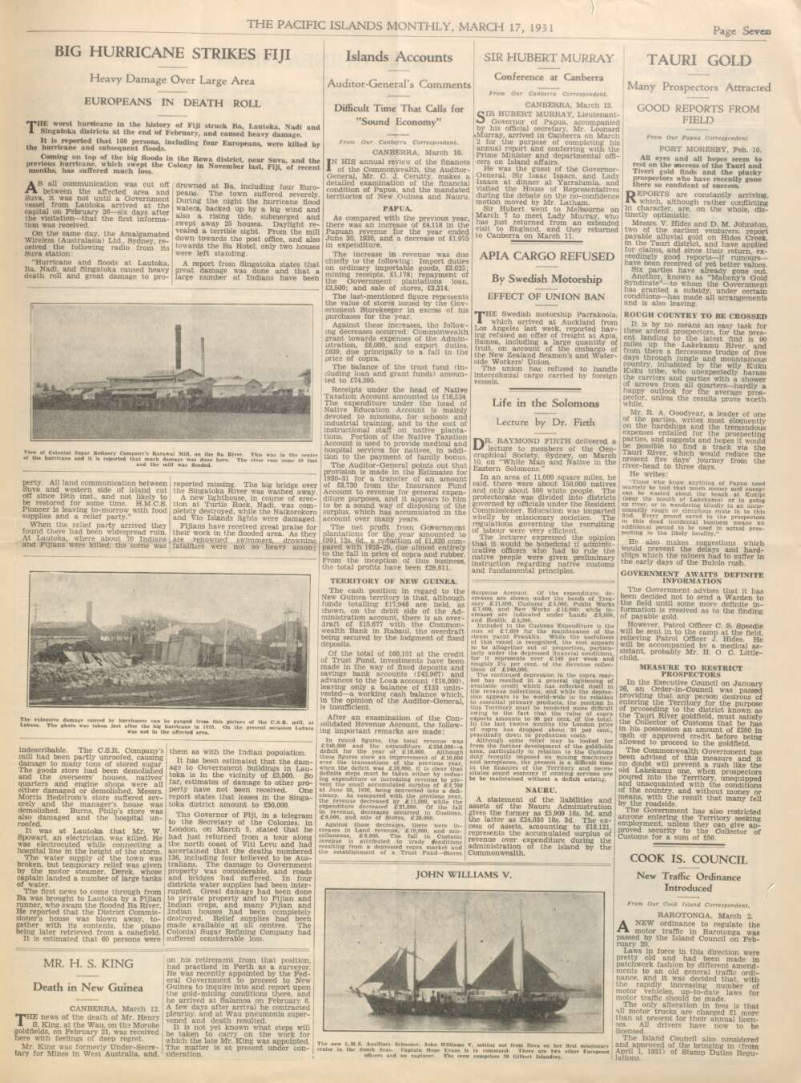
View of Colonial Sugar Refinery Company’s Rarawai Mill, on the Ba River. This was in the centre of the hurricane and it is reported that much damage was done here. The river rose some 40 feet and the mill was flooded.
The extensive damage caused by hurricanes can be gauged from this picture of the C.S.R. mill at Cabasa. The photo was taken just after the big hurricane in 1929. On the present occasion Labasa was not In the affected area.