Thursday Is. Topics
p. 10 · Read in the full issue
Shipping Prospects
From Our Own Correspondent
Thursday Island, Dec. 30.
IT is a good thing to take one's head out of the icebox, knock off studying the thermometer, and look round at the many charming gifts of Nature during this dreaded month of December.
The most striking natural feature of the month is the flowering of the Poin cianas, which turn our untidy, iron roofed village into a thing of beauty.
The hillsides and waste places of the island blaze with the scarlet blossoms, and behind them the bright young foliage ventures out in anticipation of refreshing showers. This lovely tree, the Flamboyant of the Pacific and the Golden Mohur of India, adapts itself
well to our climate, as it sheds its leaves during the long spring droughts, hold ing itself in reserve for a glorious burst of colour just when it is most needed.
There is great beauty in the sea and sky, too, at this season of the year.
Great white clouds, the argosies of the monsoon, mount into the pale blue sky from every quarter, and beneath them the sea, as still and polished as a lake, reflects their shining whiteness. They are the promise of the rains, that life giving tropical springtime that never fails to come in its due season.
Ashore, in the island streets, there is a quickening of dead bones, and the shops burst into a semblance of Street, with their windows gay with Christmas goods. An influx of youths and children from distant islands stares at it spellbound. To us, with our memories of Sydney and Melbourne this display seems rather pathetic, but to these little darkies, looking at it for the first time, shabby old T.I. becomes a place of wonder and delight—a verit able Aladdin’s cave of treasures.
And the nights of December —when the scent of flowering shrubs fills the air—are the climax of the moving year, for the stars shine brighter, the moon sails in a serener sky, than at other seasons. Away on the hillside rises the beat of drums in the romantic music of the tropics; across the sleeping water comes the sound of island songs from the cutters at anchor —songs that sound soft and tender in the distance, that hold in their rich harmonies poignant memories of the savage days of old.
And as the night grows old, sea, sky and shadowed isle sink into an exquis ite silence, trembling with promise of the tropic day to come.
Reported Extension Of
Coastal Service
Living in the far North of Queens land is an expensive luxury. When the resident of Cairns, which is only 40 hours steam away, wants his wife and family to have a change to Brisbane, he only has to put down £14 for a firstclass return ticket by coastal vessel.
But here we have to pay £39 for a journey only 80 hours longer.
It is rumoured that the big coastal steamers, which at present stop at Cairns, are going to extend to Thurs day Island during the tourist season, and if they do, Thursday Island will have an excellent opportunity to prove to Southerners what a splendid holiday ground this district is, while if propor tionate fares are charged to Brisbane there will be further cause for rejoicing.
This rumoured scheme is undoubtedly due to the difficulties and high cost of foreign travel, and many people who cannot afford to go abroad may avail themselves of the opportunity to visit Torres Straits in search of sunshine, during the coming winter.
Fighting The Java Pest
Mention of a new disease in coco nuts in Java was made in a recent number of the P.I.M. An East Indian planter tells me that much damage and loss has resulted from it.
So far, however, the pest has not made its appearance east of Celebes.
The remedy that is being used in Java is proving very effective and is an instance of the use of modern scientific methods in agriculture. Affected plan tations are treated with a poisonous gas (its exact nature he could not say, but it may be allied to cyanide) which is streamed on to the trees from low flying aeroplanes. Every living thing,
cattle, pigs, and even coolies, are re moved before treatment of the area.
From Suva To T.I.
The secretary of the Royal Geograph ical Society reports the finding of a sealed bottle at Moa Island, on October 23, 1930, which had been thrown over board from the American steamer.
Golden Bear, in lat. 14 deg. 48 nr. S., long. 178 deg. 21 hr. E. (west of Suva) on February 6, 1929. Moa is situated in lat. 10 deg. 50 hr. S., long. 142 deg. 50 hr. E.
“Quetta” Memories
The Quetta Wreck “evening” held recently under the auspices of the Royal Geographical Society of Austral asia, elicited some interesting facts in connection with that marine tragedy of the nineties.
It may be recalled that the Quetta, while on a voyage from Brisbane to London, struck an unchartered rock
near Cape York, on the night of Feb ruary 20, 1890. A scene of horror fol lowed, as the vessel sank in less than four minutes leaving 293 souls aboard to their fate in the water and of these no less than 133 perished.
The Quetta Rock as it is now called, situated some 25 miles south-east of Thursday Island, sprang into notoriety as a result of the wreck. The rock was marked on the charts many years previous to the tragedy, but its posi tion was doubtful and, after the visit of the Queensland Government’s steamer Paluma, which was sent from Brisbane expressly to determine its exact site, it was removed from the chart as non-existent, as the expedition found no traces of it. Thus does Fate play with the lives of men. The Quetta, steering direct over the hidden danger, was following a course that had been decided upon as perfectly safe. By an ironical chance, the same vessel came to carry out a new survey after the wreck, and with the correct bearings in their possession, the rock was found.
The ill-fated Quetta was located some 200 yards away in deep w'ater.
At the meeting, the Lord Bishop of Carpentaria read extracts from the log of the Government steamer, Albatros, stationed at Thursday Island, which was despatched to the scene of the wreck immediately after the receipt of the news on the island, but it fell to the lot of Mr. H. G. Vidgen, a son-in law of Frank Jardine’s, to supply some personal reminiscences of great inter est.
The most notable figure among those who assisted in the rescue work was undoubtedly the late Mr. Frank Jar dine, the pioneer of Cape York, who lived at Somerset, the nearest point of the mainland to the scene of the dis aster.
The “Quetta evening” marked the final meeting of the Geographical Soci ety for 1930, and was attended by many visitors, who listened with great interest to the amazing tales that were told of this appalling tragedy.
Colonel A. J. Bennett, Administrator of Norfolk Island, sailed for N.I., by the Makambo, on January 3. During six weeks spent in Australia he con ferred with the Federal authorities at Canberra concerning administration and other matters.
Rev. J. A. Crump, who served for ten years as a Methodist missionary on New Britain, has died at Blenheim, New Zealand. His outstanding work in New Guinea was the starting of mission plantations at Ulu.
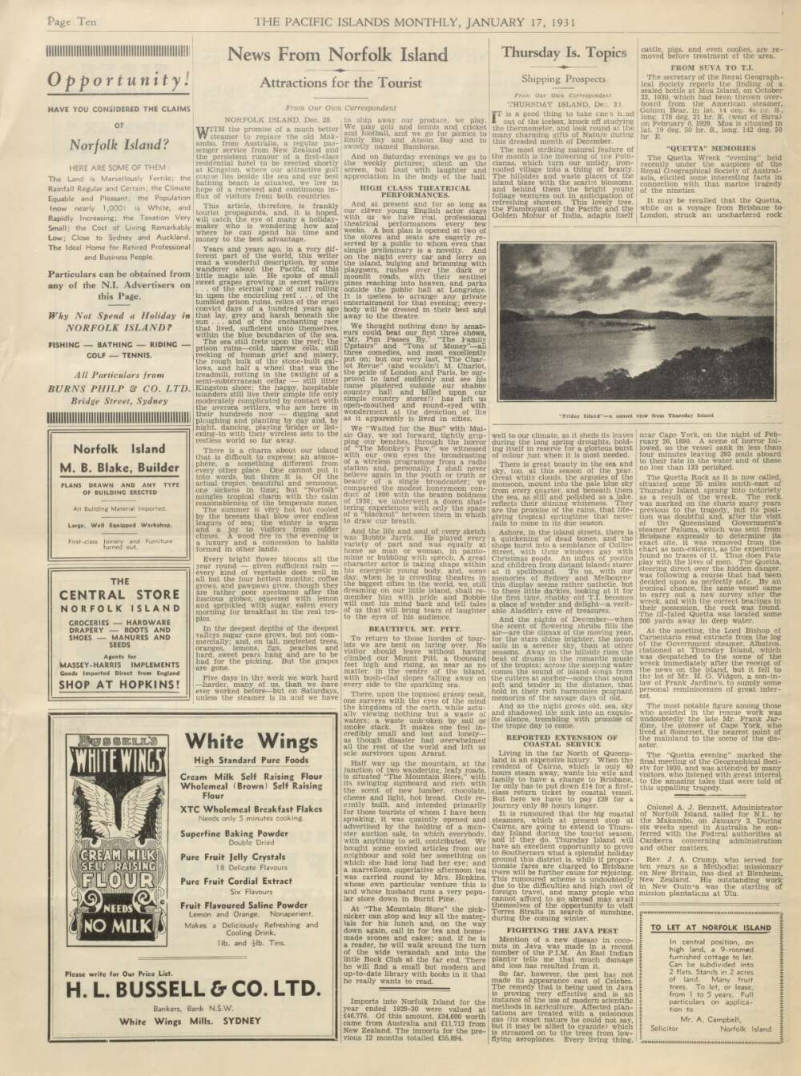
“Friday Island”—a sunset view from Thursday Island