Papuan News
Good Market for Desiccated Coconut —Rubber Plantations Again Producing—Successful Coffee Growing—Rain Badly Needed
From Our Own Correspondent
Port Moresby, Dec. 20.
The price of copra is still low, and the plantations, not able to avail themselves of the desiccated coconut factories, are still having a thin time.
It would appear to be an excellent opportunity for yet another factory to open and avail itself of the good sales of desiccated coconut in Australia, due to the revised tariffs.
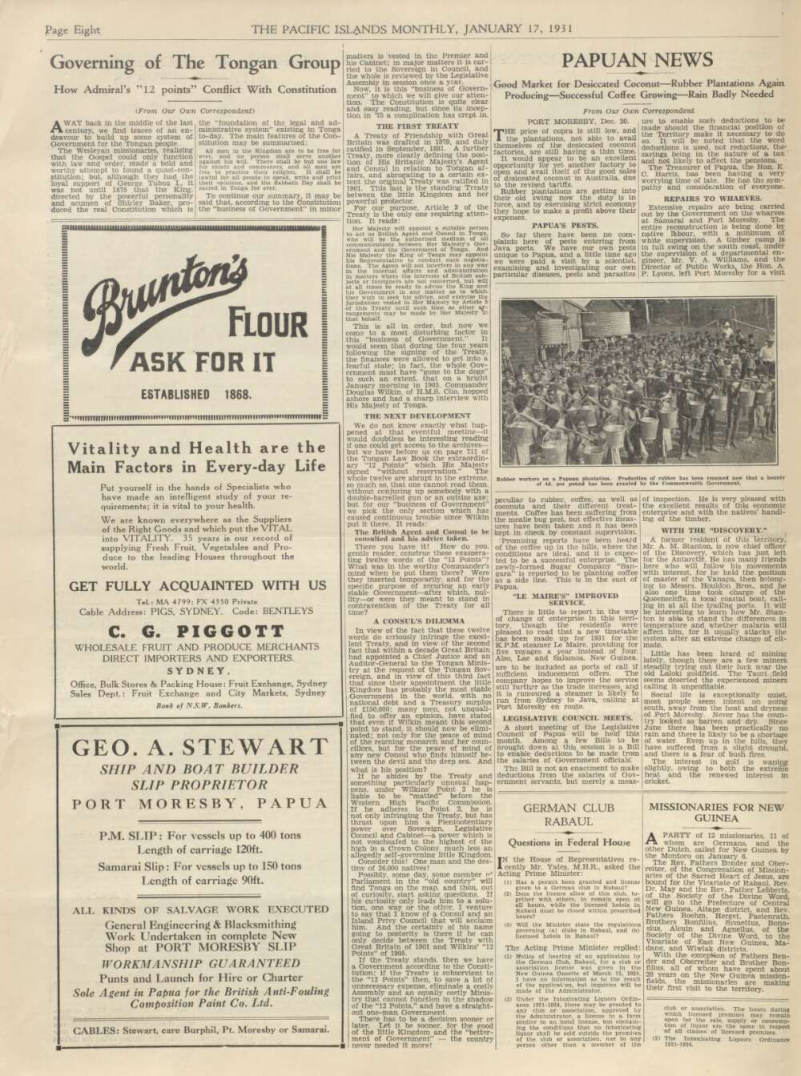
Rubber plantations are getting into their old swing now the duty is in force and by exercising strict economy they hope to make a profit above their expenses.
Papua’S Pests.
So far there have been no com plaints here of pests entering from Java ports. We have our own pests unique to Papua, and a little time ago we were paid a visit by a scientist, examining and investigating our own particular diseases, pests and parasites
ure to enable such deductions to be made should the financial position of the Territory make it necessary to do so. It will be noted that the word deductions is used, hot reductions, the savings being in the nature of a tax and not likely to affect the pensions.
The Treasurer of Papua, the Hon. E.
C. Harris, has been having a very worrying time of late. He has the sym pathy and consideration of everyone.
Repairs To Wharves.
Extensive repairs are being carried out by the Government on the wharves at Samarai and Port Moresby. The entire reconstruction is being done by native labour, with a minimum of white supervision. A timber camp is in full swing on the south coast, under the supervision of a departmental en gineer, Mr. V. A. Williams, and the Director of Public Works the Hon. A.
P. Lyons, left Port Moresby for a visit
peculiar to rubber, coffee, as well as coconuts and their different treat ments. Coffee has been suffering from the mealie bug pest, but effective meas ures have been taken and it has been kept in check by constant supervision.
Promising reports have been heard of the coffee up in the hills, where the conditions are ideal, and it is expec ted to be a successful enterprise. The newly-formed Sugar Company “San gara” is reported to be planting coffee as a side line. This is in the east of Papua.
“Le Maire’S” Improved
Service.
There is little to report in the way of change of enterprise in this terri tory, though the residents were pleased to read that a new timetable has been made up for 1931 for the K.P.M. steamer Le Maire, providing for five voyages a year instead of four.
Also, Lae and Salamoa, New Guinea, are to be included as ports of call if sufficient inducement offers. The company hopes to improve the service still further as the trade increases, and it is rumoured a steamer is likely to run from Sydney to Java, calling at Port Moresby en route.
Legislative Council Meets.
A short meeting of the Legislative Council of Papua will be held this month. Among a few Bills to be brought down at this session is a Bill to enable deductions to be made from the salaries of Government officials.
The Bill is not an enactment to make deductions from the salaries of Gov ernment servants, but merely a meas
of inspection. He is very pleased with the excellent results of this economic enterprise and with the natives’ handl ing of the timber.
With The “Discovery.”
A former resident of this territory, Mr. A. M. Stanton, is now chief officer of the Discovery, which has just left for the Antarctic. He has many friends here who will follow his movements with interest, for he held the position of master of the Vanapa, then belong ing to Messrs. Houldon Bros., and he also one time took charge of the Queenscliffe, a local coastal boat, call ing in at all the trading ports. It will be interesting to learn how Mr. Stan ton is able to stand the differences in temperature and whether malaria will affect him, for it usually attacks the system after an extreme change of cli mate.
Little has been heard of mining lately, though there are a few miners steadily trying out their luck near the old Laloki goldfield. The Tauri field seems deserted the experienced miners calling it unprofitable.
Social life is exceptionally quiet, most people seem intent on going south, away from the heat and dryness of Port Moresby. Never has the coun try looked so barren and dry. Since June there has been practically no rain and there is likely to be a shortage of water. Even up in the hills, they have suffered from a slight drought, and there is a fear of bush fires.
The interest in golf is waning slightly, owing to both the extreme heat and the renewed interest in cricket.
Rubber workers on a Papuan plantation. Production of rubber has been resumed now that a bounty of 4d. per pound has been granted by the Commonwealth Government.