Cattle-Farming
Agriculture And
Bougainville Possibilities
Views Of Botanist
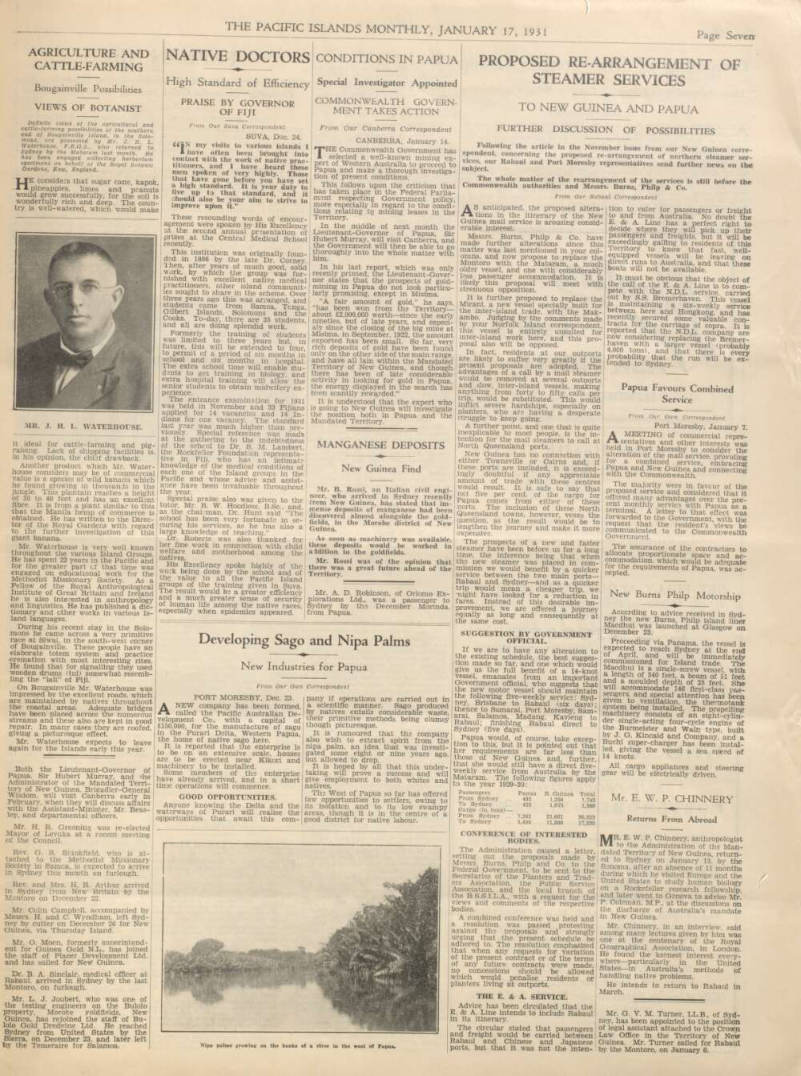
Definite views of the agricultural and cattle-farming possibilities of the southern end of Bougainville Island, in the Solo mons, are possessed by Mr J H L Waterhouse, F.R.G.S., who returned to Sydney by the Mataram last month. He has been engaged collecting herbarium specimens on behalf of the Royal Botanic Gardens, Kew, England.
HE considers that sugar cane, kapok, pineapples, limes and peanuts would grow successfully, for the soil is wonderfully rich and deep. The coun try is well-watered, which would make
it ideal for cattle-farming and pig raising. Lack of shipping facilities is, in his opinion, the chief drawback.
Another product which Mr. Water house considers may be of commercial value is a species of wild banana which he found growing in thousands in the jungle. This plantain reaches a height of 30 to 40 feet and has an excellent fibre. It is from a plant similar to this that the Manila hemp of commerce is obtained. He has written to the Direc tor of the Royal Gardens with regard to the further investigation of this giant banana.
Mr. Waterhouse is very well known throughout the various Island Groups.
He has spent 22 years in the Pacific and for the greater part cf that time was engaged on educational work for the Methodist Missionary Society. As a Fellow of the Royal Anthropological Institute of Great Britain and Ireland he is also interested in anthropology and linguistics. He has published a dic tionary and ether works in various Is land languages.
During his recent stay in the Solo mons he came across a very primitive race at Siwai. in the south-west corner of Bougainville. These people have an elaborate totem system and practice cremation with most interesting rites.
He found that for signalling they used wooden drums (tui) somewhat resemb ling the “lali” of Fiji.
On Bougainville Mr. Waterhouse was impressed by the excellent roads, which are maintained by natives throughout the coastal areas. Adequate bridges have been placed across the numerous streams and these also are kept in good repair. In many cases they are roofed giving a picturesque effect.
Mr. Waterhouse expects to leave again for the Islands early this year.
Both the Lieutenant-Governor of Papua, Sir Hubert Murray, and the Administrator of the Mandated Terri tory of New Guinea, Brigadier-General Wisdom, will visit Canberra early in February, when they will discuss affairs with the Assistant-Minister, Mr. Beas ley, and departmental officers.
Mr. H. R. Greening was re-elected Mayor of Levuka at a recent meeting of the Council.
Rev. G. S. Shinkfield, who is at tached to the Methodist Missionary Society in Samoa, is expected to arrive in Sydney this month on furlough.
Rev. and Mrs. H. R. Arthur arrived in Sydney from New Britain by the Montoro on December 22.
Mr. Colin Campbell, accompanied by Messrs. H. and C. Wyndham, left Syd ney by cutter on December 26 for New Guinea, via Thursday Island.
Mr. O. Moen, formerly sunerintend ent for Guinea Gold N.L., has joined the staff of Placer Development Ltd. and has sailed for New Guinea.
Dr. B. A. Sinclair, medical officer at Rabaul, arrived in Sydney by the last Montoro, on furlough.
Mr. L. J. Joubert. who was one of the testing engineers on the Bulolo property, Morobe goldfields, New Guinea, has rejoined the staff of Bu lolo Gold Dredslne Ltd. He reached Sydney from United States by the Sierra, on December 23, and later left by the Temeraire for Salamoa.