Need For Closer Relationship
pp. 1-2 · Read in the full issue
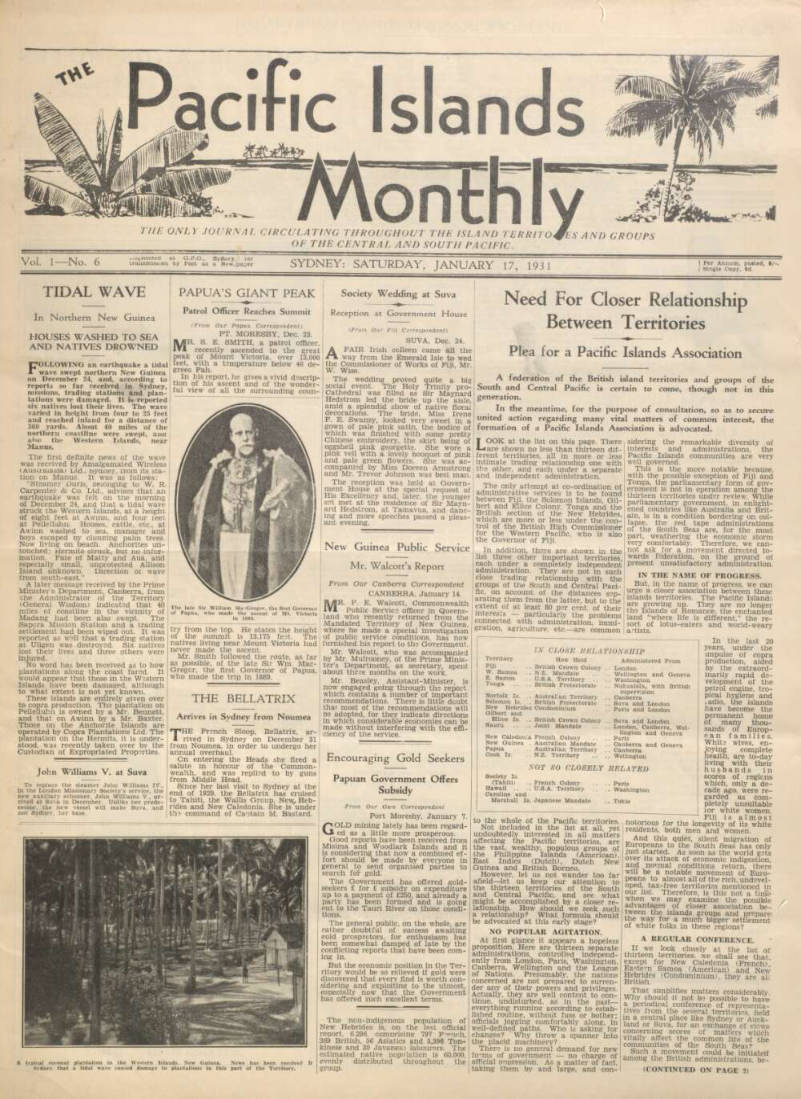
Between Territories ———♦——— Plea for a Pacific Islands Association
A federation of the British island territories and groups of the South and Central Pacific is certain to come, though not in this generation.
In the meantime, for the purpose of consultation, so as to secure united action regarding many vital matters of common interest, the formation of a Pacific Islands Association is advocated.
LOOK at the list on this page. There are shown no less than thirteen different territories, all in more or less intimate trading relationship one with the other, and each under a separate and independent administration.
The only attempt at co-ordination of administrative services is to be found between Fiji, the Solomon Islands, Gilbert and Ellice Colony, Tonga and the British section of the New Hebrides, which are more or less under the control of the British High Commissioner for the Western Pacific, who is also the Governor of Fiji.
In addition, there are shown in the list three other important territories, each under a completely independent administration. They are not in such close trading relationship with the groups of the South and Central Pacific, on account of the distances separating them from the latter, but to the extent of at least 80 per cent, of their interests — particularly the problems connected with administration, immigration, agriculture, etc.—are common ...
In Close Relationship
Territory ... How Held ... Administered From Fiji ... British Crown Colony ... London W. Samoa ... N.Z. Mandate .. ... Wellington and Geneva E. Samoa ... U.S.A. Territory .. ... Washington Tonga .. ... British Protectorate ... Nukualofa, with British ... supervision Norfolk Is. ... Australian Territory ... Canberra Solomon Is. .. British Protectorate ... Suva and London New Hebrides Condominium ... .. Paris and London Gilbert and Ellice Is. ... British Crown Colony ... Suva and London Nauru ... Joint Mandate .. ... London, Canberra, Wel ... lington and Geneva New Caledonia French Colony ... Paris New Guinea . Australian Mandate ... Canberra and Geneva Papua ... Australian Territory ... Canberra Cook Is. ... N.Z. Territory ... Wellington
Not So Closely Related
Society Is. (Tahiti) ... French Colony ... Paris Hawaii ... U.S.A. Territory ... Washington Caroline and Marshall Is... Japanese Mandate ... Tokio ...
to the whole of the Pacific territories.
Not included in the list at all, yet undoubtedly interested in all matters affecting the Pacific territories, are the vast, wealthy, populous groups of the Philippine Islands (American), East Indies (Dutch), Dutch New Guinea and British Borneo.
However, let us not wander too far afield—let us keep our attention to the thirteen territories of the South and Central Pacific, and see what might be accomplished by a closer relationship. How should we seek such a relationship? What formula should be advocated at this early stage?
No Popular Agitation.
At first glance it appears a hopeless proposition. Here are thirteen separate administrations, controlled independently from London, Paris, Washington, Canberra, Wellington and the League of Nations. Presumably, the nations concerned are not prepared to surrender any of their powers and privileges.
Actually, they are well content to continue, undisturbed, as in the past— everything running according to established routine, without fuss or bother; officials jogging comfortably along, in well-defined paths. Who is asking for changes? Why throw a spanner into the placid machinery?
There is no general demand for new forms of government no charge of official oppression. As a matter of fact, taking them by and large, and con-
sidering the remarkable diversity of interests and administrations, the Pacific Islands communities are very well governed.
This is the more notable because, with the possible exception of Fiji and Tonga, the parliamentary form of government is not in operation among the thirteen territories under review. While parliamentary government, in enlightened countries like Australia and Britain, is in a condition bordering on collapse, the red tape administrations of the South Seas are, for the most part, weathering the economic storm very comfortably. Therefore, we cannot ask for a movement directed towards federation, on the ground of present unsatisfactory administration.
In The Name Of Progress.
But, in the name of progress, we can urge a closer association between these islands territories. The Pacific Islands are growing up. They are no longer the Islands of Romance, the enchanted land “where life is different,” the resort of lotus-eaters and world-weary artists.
In the last 20 years, under the impulse of copra production, aided by the extraordinarily rapid development of the petrol engine, tropical hygiene and radio, the islands have become the permanent home of many thousands of European families.
White wives, enjoying complete health, are to-day living with their husbands in scores of regions which, only a decade ago, were regarded as completely unsuitable for white women.
Fiji is almost
notorious for the longevity of its white residents, both men and women.
And this quiet, silent migration of Europeans to the South Seas has only just started. As soon as the world gets over its attack of economic indigestion, and normal conditions return, there will be a notable movement of Europeans to almost all of the rich, undeveloped, tax-free territories mentioned in our list. Therefore, is this not a time when we may examine the possible advantages of closer association be tween the islands groups and prepare the way for a much bigger settlement of white folks in these regions?
A Regular Conference.
If we look closely at the list of thirteen territories, we shall see that except for New Caledonia (French), Eastern Samoa (American) and New Hebrides (Condominium), they are all British.
That simplifies matters considerably.
Why should it not be possible to have a periodical conference of representatives from the several territories held in a central place like Sydney or Auckland or Suva, for an exchange of views concerning scores of matters which vitally affect the common life of the communities of the South Seas?
Such a movement could be initiated among the British administrations be-
(Continued On Page 2)
there is every reason to believe that our French friends in New Caledonia, Tahiti, New Hebrides, as well as Americans representing Eastern Samoa and Hawaii, and probably Japanese from the Marshalls and Carolines, would join in heartily.
Consider the matters which could be discussed with mutual profit, just at the present time.
The bottom has fallen out of the copra market, and every planter, from
Papua to Tahiti, and from Tonga to the Philippines, is seeking an alternative, quick-growing crop, to carry him through the lean years. Men from the different territories, bringing their knowledge and experience to a common centre, would provide information of incalculable value to the whole Pacific.
Another problem, which could be most profitably discussed just now, is labour. There is a demand from more than one territory that, since “big fellow boss” is taking it fairly in the neck in the matter of copra prices, and is likely to do so for some time to come, the price of native labour should be reduced, at least, for a time. This, surely, is a matter in which some attempt should be made to secure common action.
Then there is the ever present subject of pests. It is a matter concern ing which planters, as a body, must maintain constant vigilance. A moment’s carelessness may wipe out the life work of a hundred men. At the present moment, over in Java, a mysterious moth is playing havoc with the coconut plantations. New Guinea, where many hundreds of planters and the Commonwealth of Australia have enormous sums invested in coconuts, is next door to Java. Yet no one seems to know very much about the new pest, or whether it is a new pest; and apparently nothing has been done to keep it out of the Mandated Territory.
Remarkable work in wiping out insect pests by the introduction of other insects, has been done by the entomologists of Fiji; but no machinery exists for keeping other administrations regularly informed of these valuable discoveries in the realm of pest control.
And so on. The list could be multiplied, almost without limit, by any man familiar with islands life and conditions.
Interests To Be Represented.
We suggest that a body should be formed, to be called The Pacific Islands Association, and that there should be branches of the organisation, wherever desired, in any territory, group or island, and, if required, in Australia and New Zealand. Its main object should be the consideration and discussion of all matters of common interests to the islands communities, and the dissemination of information relating thereto; and, as part of this, it should endeavour to hold a regular conference annually if possible —at which recommendations of some weight and authority might be formulated. So far as the constitution of the conference is concerned, it seems to us that care should be taken to give representation to the six main interests, namely : 1. The administrations. 2. The planters and producers. 3. The merchants and traders. 4. The educated natives. 5. The missionary organisations responsible for educational activities. 6. The interests responsible for providing means of communication.
We suggest that each of these interests is deeply concerned with the future of the Pacific territories, and that, in framing the rules of The Pacific Islands Association, care should be taken to provide facilities for the expression of the views of all of them.
We are tempted to essay the task of outlining a set of rules and conditions; but that, obviously, should be the duty of the many available men of wisdom and experience, gained in a lifetime of association with Pacific Islands affairs. The main consideration is that the association should be loosely-formed and wide open, to permit the inclusion of all sorts and conditions of people and interests. It will not fulfil its purpose, for instance, if its constitution should remain wholly British.
No Legislative Power.
It is not suggested that the association should have anything resembling legislative powers. It would provide machinery merely for discussions and for making recommendations. But it is obvious that, if it were conducted in a proper manner, it would receive the goodwill and support of the various Governments and islands administrations concerned not only because it would bring to a focussing point for the guidance of administrators the knowledge and experience of men from all parts of the Pacific, but also be cause it would introduce into Pacific Islands administration a factor of coordination, which is the thing that is conspicuously lacking throughout the several administrations to-day.
The Defence Factor.
Perhaps, before closing this article, it would be wise to mention another, and, maybe, the most insistent reason in favour of the formation of The Pacific Islands Association.
The territories of the Central and South Pacific are in the hands of
Britain and France, they are capable of supporting in comfort and happiness a very large population. The Europeans are in possession, and it is their wish that whatever population is carried there, in addition to the natives, shall be European. But, just over the Equator, looking out anxiously and hopelessly for new lands which they may occupy, are the countless, swarming millions of Asia. Officially, they are being kept out of the islands.
Actually, they are creeping in, creeping in in an ever-increasing stream.
Already in places they are an embarrassment.
It is of the utmost importance that here, at any rate, the French and the different British administrations should have a common policy, if only for defence reasons. Are the islands to be kept for the white race, as the administration is endeavouring to do in New Guinea? Or is there to be a limited infiltration of Asiatics, as in Fiji? Or is the indenture system of using and repatriating Asiatic labour to be strictly followed, as in New Hebrides and New Caledonia? Or are the Chinese trading classes to be allowed to become the dominant commercial class, as in the Straits Settlement? Or are the Japanese and Chinese to be permitted to swarm over and outnumber the natives, as in Hawaii?
Surely, the answer to these questions ought not to be too long delayed.—